Do All Roads Lead to the Terms of Trade? (2)
When observing the long-term trend of the terms of trade between Japan and the United States, we see that while the United States has maintained a stable (and recently rising) trend, Japan has experienced a gradual decline since the late 1990s.
A deterioration in the terms of trade leads to a reduction in the gains obtained from foreign trade. In this discussion, we will confirm what this means.
The terms of trade are also related to trade balances, real exchange rates, and wages, but we will address these topics at another time.
Terms of Trade (ToT)
The ratio of export prices to import prices is referred to as the terms of trade. An improvement in this ratio (a larger value) means that the country’s exports are sold at higher prices and imports are purchased at lower prices. As a result, the country can obtain more imports with the same amount of exports, thereby enhancing its purchasing power.
– Gains from Trade: The profit obtained when the terms of trade improve compared to a baseline, resulting in increased purchasing power, is called gains from trade. An increase in gains from trade means that the real wealth of the nation has increased. The Cabinet Office’s website provides an explanation with formulas.
– Losses from Trade: When the terms of trade worsen compared to a baseline, leading to a decrease in purchasing power, this decrease is referred to as losses from trade.
– Real GDP and Gains from Trade:
– Real Gross Domestic Product (GDP) measures the total value of goods and services produced by a country within a certain period, adjusted for price changes from a baseline.
– Adding gains from trade to real GDP provides Real Gross Domestic Income (GDI), a measure of the nation’s overall real purchasing power.
– Real GDI = Real GDP + Gains from Trade
The Gradual Decline in Japan’s Terms of Trade
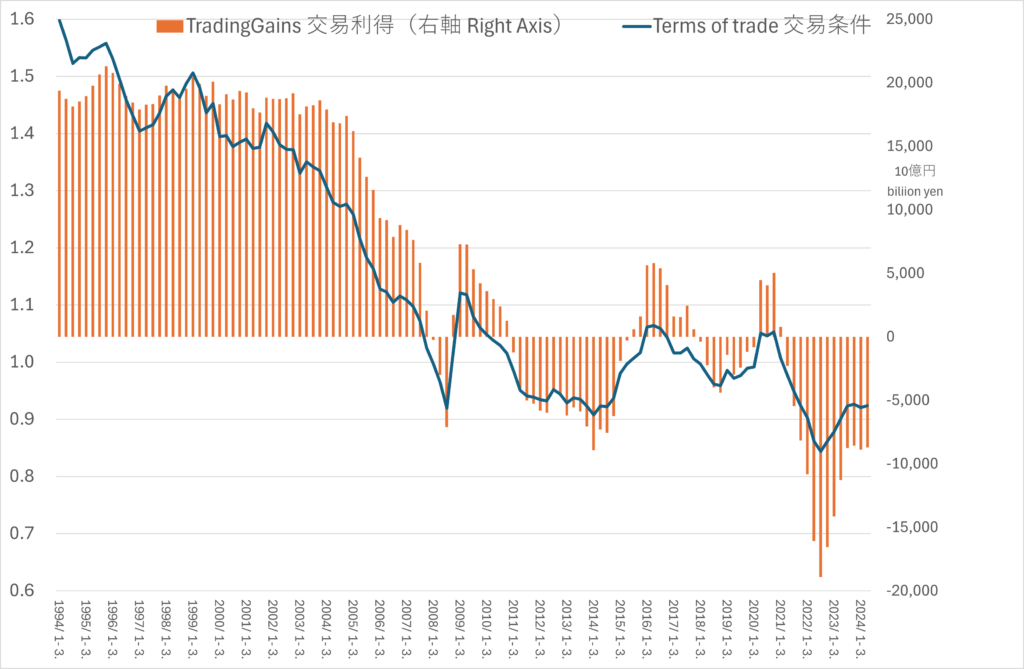
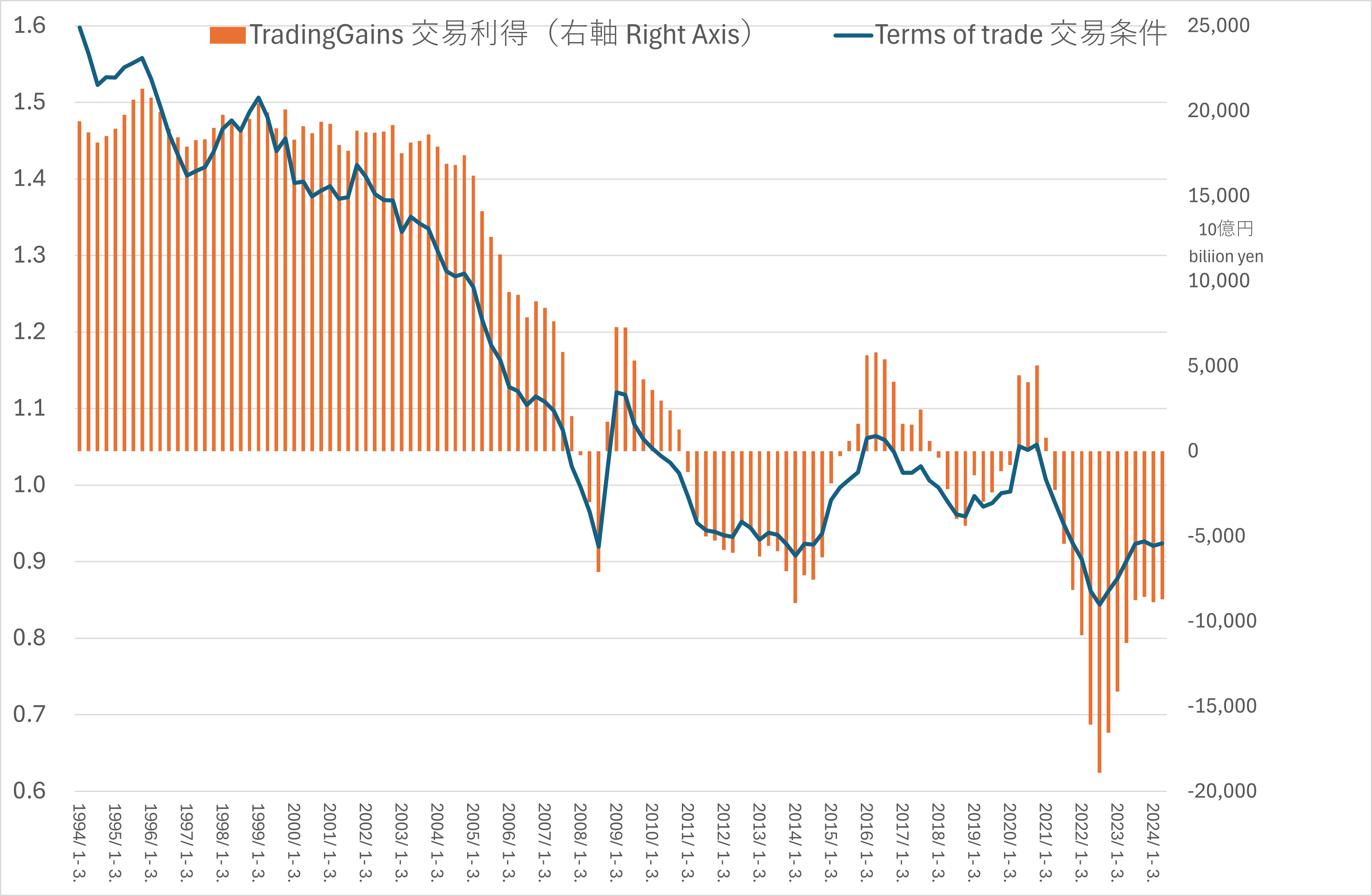
The terms of trade can be calculated by dividing the export price index by the import price index, which is derived from the export and import deflators in GDP statistics. Gains from trade are also recorded in the real GDP tables. The current GDP statistics use 2015 prices as the base, with calculations available going back to 1994.
As seen in the graph, with the deterioration of the terms of trade, gains from trade have also been on a downward trend since the 2000s. Since 2008, losses from trade have occurred, meaning that real GDI has been smaller than real GDP. This indicates that, in real terms, the nation’s purchasing power (real income) has become smaller than its production output.
Long-term Trend of the Terms of Trade: A Comparison between Japan and the United States
The terms of trade can be calculated not only from GDP statistics but also from the export and import price indices within corporate price data, which is available on a monthly basis. Data for the United States can be obtained from the Federal Reserve Bank of St. Louis’s FRED, and data for Japan can be retrieved from the Bank of Japan’s time-series statistical data search site.
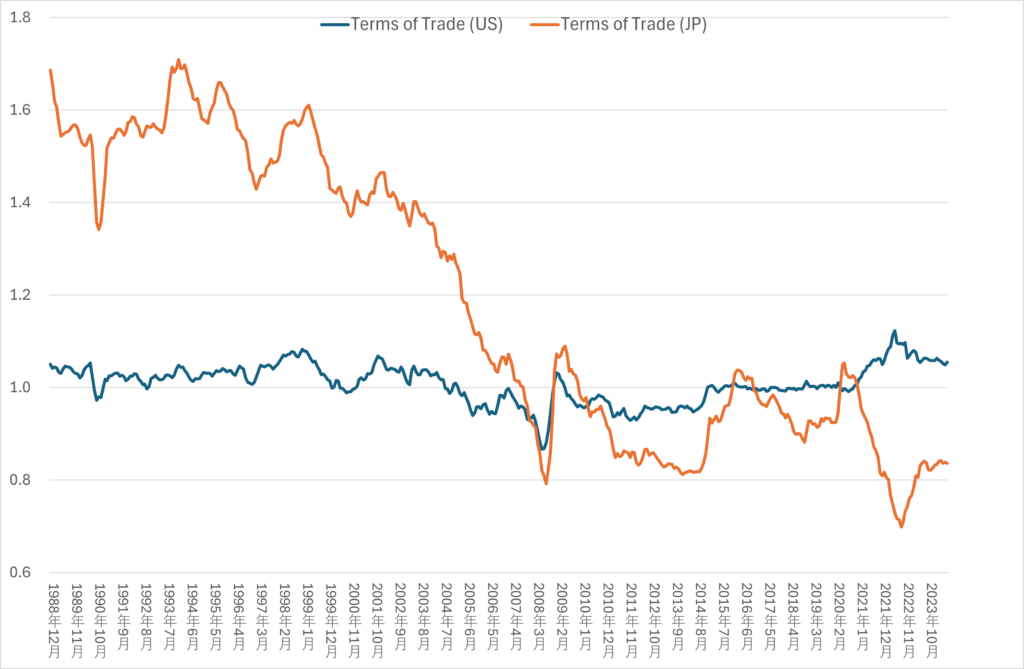
The graph above shows monthly data from December 1988 to July 2024. While the terms of trade in the United States have remained stable, Japan’s terms of trade have shown significant fluctuations and a gradual decline since the late 1990s.
The long-term trend of Japan’s terms of trade has followed a similar path to the yen’s real effective exchange rate.
On the other hand, even if profits earned overseas increase consolidated EPS and boost Japanese stocks, unless these overseas profits are reinvested in domestic capital expenditures or wage increases, there is little difference for Japanese investors between investing in Japanese stocks and foreign stocks.
Various factors seem to be linked to the deterioration of the terms of trade.
\ 最新情報をチェック /